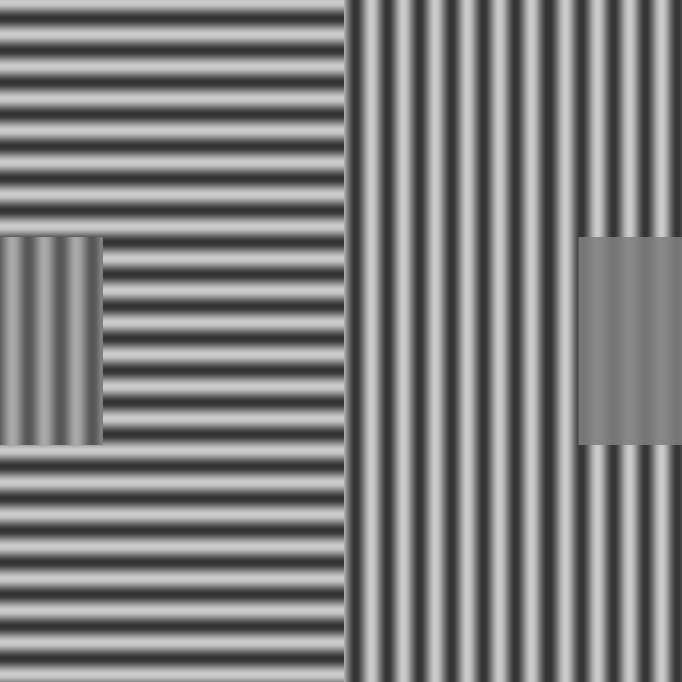
(Beware, this is a little boring…) Above are two large gratings, the left with horizontal stripes, the right with vertical stripes. In the center of these are two smaller gratings with vertical stripes. The center gratings differ a little in contrast, with a randomized difference on each press of Reset.
Your task is to make the contrast of the two center stripes identical with the slider at the right. Compare the two center gratings and try to ignore the surround. To concentrate more on the gratings, you can switch off the slider and use the cursor keys instead.
When you are satisfied, deselect the Surround checkbox. Now, in all likelihood, the center gratings will not look alike anymore. The Results show the central gratings’ contrast quantitatively.
This display was used in an actual experiment (Nickel et al. 2024, another one of the fruitful cooperation between eye center and psychiatry). That’s why much here can be commandeered with shortcut keys (e.g., pressing the space bar shows results and copies them to the clipboard for further processing). Experimental conditions were selected with the pop-up for spatial frequency, contrast etc.
On the right, the large surrounding grating has the same orientation as the test grating in the center. That “suppresses” the contrast of the test grating a little, and its contrast has to be increased to look like the non-suppressed grating on the left. If surround and center differ in orientation, no such suppression occurs.
To cite (modified) from our paper: Center-surround contrast suppression typically occurs when a luminance-modulated central patch (e.g. sinusoidal grating) of low contrast is presented on a high-contrast background pattern with similar spatial features like the same orientation (collinear) and spatial frequency. Contrast suppression is less pronounced when the center and surround patterns differ in orientation, particularly evident when they are orthogonal (Solomon et al., 1993). This orientation specificity suggests involvement of post-retinal processing sites, most likely cortical areas, in contrast suppression (surprisingly also reported in the LGN (Poltoratski et al., 2016), but that’s only an abstract).
Nickel, Heinrich, Beringer, Endres, Runge, Küchlin, Maier, Bach, Domschke, Tebartz van Elst, Friedel (2024) Alterations in center-surround contrast suppression in patients with major depressive disorder. Sci Rep 14:28160.
Nguyen, Ramakrishnan, Narayanan, Hussaindeen & McKendrick (2023) Perceptual center-surround contrast suppression in adolescence. Invest Ophthalmology Vis Sci 64, 14
Solomon, Sperling & Chubb (1993) The lateral inhibition of perceived contrast is indifferent to on-center/off-center segregation, but specific to orientation. Vision Res 33, 2671–2683
Chubb, Sperling & Solomon (1989) Texture interactions determine perceived contrast. Proc Natl Acad Sci USA 86, 9631–9635
Petrov, Carandini & McKee(2005) Two distinct mechanisms of suppression in human vision. J Neurosci 25, 8704–8707
Poltoratski, McCormack & Tong (2016) Orientation-tuned surround suppression in the human LGN. J Vis 16, 875