If you look at the blue shape above, in all likelihood you will immediately perceive a cube, slowly rotating.
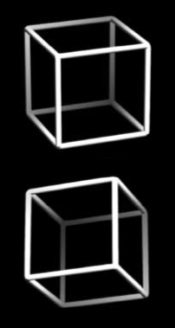
Now press the View 1, so that we can see this at leisure. If you view the cube for a prolonged time, you may perceive sudden perceptual reversal (typically every 3–5 s) between the two cube orientations as depicted on the right. There the front-back sides of the cube are clearly indicated by depth shading. In the blue Necker cube above, however, both orientations are possible. By the way: Perceptual reversals of a rotating cube are accompanied by reversals of rotation direction.
Impossible button, the rotation is reset to the primary position, and a green rod is pushed from the left into the cubic wireframe. Is the final position possible? This is a case of an impossible figure, and not related to the Necker cube phenomenon. What is interesting though: for me, the impossible figure is much less stable than the Necker cube, undergoing more frequent reversals.Why does the Necker cube reverse? First, we need to appreciate that the percept of a 3-dimensional wireframe cube is already an interpretation, which our brain performs on the 2-dimensional visual input of a flat line image on the screen. Given this image, many interpretations are possible (for instance, many wire zigzags could cast this same shadow), but our brain chooses a cube as the most likely interpretation. And both orientations are about quite as likely (the top one of the two disambiguated figures is a little more often seen).
So we understand why we see a cube, but why does it reverse? I figure the two possible perceptual states as attractors in percept space. Once the percept “sits” in one attractor, it feels at home, but through adaptation the attractor becomes shallower. By any perturbation, be it blinks, eye movements or “top-down commands”, the percept can move to the other, not adapted attractor, to renew this game.
The Necker cube has interested observers from many disciplines because it seems to allow decoupling of seeing and perceiving: Although the image remains identical, the percept changes. There is a huge amount of literature on this, which I can’t even begin to cover here. Long & Toppino (2004) gave a comprehensive review.
L. A. Necker was a Swiss mineralogist. He discovered the reversals by accident when looking at the drawing of a cube-like crystal.
Necker LA (1832) Observations on some remarkable phenomenon which occurs in viewing a figure of a crystal or geometrical solid. London and Edinburgh Phil Mag J Sci 3:329–337
Long GM & Toppino TC (2004) Enduring interest in perceptual ambiguity: Alternating views of reversible figures. Psychological Bulletin, 130(5), 748–768
Kornmeier J, Bach M (2012) Ambiguous figures – What happens in the brain if perception changes but not the stimulus. Frontiers Human Neurosci 6:51 [PDF]
Projects in my laboratory: What happens in the brain when ambiguous figure reverse?
Thanks to Jürgen Kornmeier for a rewarding & relaxing collaboration and help in phrasing the above description.
The “missing corner cube”and the rotating silhouhette are related to the Necker cube phenomenon.
Clément G, Allaway HCM, Demel M, Golemis A, Kindrat AN, Melinyshyn AN, Merali T, Thirsk R (2015) Long-Duration Spaceflight Increases Depth Ambiguity of Reversible Perspective Figures. PLOS ONE 10:e0132317. doi:</p> </div>
